Tag Archives: Ella Sharples

Melbourne

Melbourne

We flew from Tasmania to Melbourne for a week after which we feel we can scientifically compare the great rival cities of Melbourne and Sydney.
I thought people from Sydney were called Sheila and Wayne, but apparently they’re called Sydneysiders. And one thing that many of them do is to over-exaggeratedly swing their arms when they walk. It was one of those things that, when you point it out you then see all over the place. 
Melbourne had a very different feel. It doesn’t have the wow factor that Sydney has with the harbour, bridge, opera house (and people there keep their arms sensibly close to their bodies), but Melbourne feels much quirkier and characterful. Better cafés and better coffees. And there are free trams in the city centre! 
We went to the cathedral in Melbourne for a Good Friday service – Stainer’s Crucifixion was being sung, primarily by the choir but we were allowed to join in a few hymns. I read that Stainer himself didn’t think much of what he had written. Say what you want about him, he was a good judge.
Watching the news on Easter Day was a little odd compared to the UK as they had quite a long news report on church services and the meaning of Easter and they showed a fair number of interviews with people about why they were at church. It was all done in a relaxed and very natural way – it wouldn’t have been reported nearly so openly in Britain.
On Easter Monday I went to my first Aussie Rules Football game. It’s a sort of cross between rugby, soccer, basketball and a punch up outside a night club. 
I enjoyed it.
It was at the Melbourne Cricket Ground which housed the cricket World Cup final the week before in which Australia beat New Zealand to much antipodean joy and despair. It had been transformed from a cricket pitch to an Aussie Rules pitch by taking the stumps out, drawing a big square and two big semi circles and sticking quite a few goal posts here and there. It was the first game of the season for Hawthorne Hawks, last year’s league winners, against their arch rivals the Geelong Cats. Nearly 80,000 were watching and it seemed a pretty good, if massively one sided game with the Hawks whupping the Cats 123 to 61. 
Basic rules as far as I could make out: you have to try and kick the ball through the middle two of the four goal posts and if you do that you get 6 points but if you only manage to get it between one of the middle and outer posts instead then they give you a point for trying. That’s the encouraging Australian way.
There was a lot of dropping the ball and fumbling after it on the floor and people ran into one another fairly frequently and someone got a bit knocked out. It looked like a Scotland rugby training session. 
I was supporting the Hawks so I can hold my head high. “Go Hawks”.
Teams in various sports often take to the field to the sound of a particularly rousing and emotive song. “We are the champions” or “We will rock you” or something similarly inspiring… If you get the chance, please, please listen to the youtube clips of the anthems for the Hawthorn Hawks and the Geelong Cats. These were what the rough, tough, Aussie rules players came out to on Monday, I kid you not.
For the Hawthorns go to
http://www.youtube.com/watch?v=Cfy4LFWn5Rg

For the Geelong song go to
http://www.youtube.com/watch?v=ukW4VVCV9LQ

Honest – these are what the crowds sing and the players get pumped up to – it was like some bizarre Monty Python sketch. Each of the main league teams have a song of the same ilk. Let the English Premier League take note!!
And, in passing, is it only in Australia that they get to rename the global phenomenon that is McDonald’s? Here, it’s called Macca’s. 

Gotta love Australia. 


Hitch Hiking

Hitch Hiking.

Having flown from Melbourne to Auckland we stayed the night in the 38th different bed since leaving the Rectory in November! And in the morning we set off bright and early to start a three day trip down to the south of North Island. Looking to save money we decided to try our hand at hitch hiking. We had arranged people to stay with for the following two nights in a sort of zig-zag across the country we just needed to get to them using our thumbs.
A brief “How To” guide for getting lifts by standing at the side of the road in New Zealand.
How do you entice people to stop their comfortable cars while they’re driving along and invite two total strangers who might well, for all you know, have issues, fleas, weapons, really irritating laughs or possibly all of the above? Well, being two middle aged would-be hitch hikers (just typed that and the iPad rewrote it as kitsch hikers which is kind of sweet) we thought the best way of getting lifts would be to carry awesome signs.
We had all sorts of signs planned but the practicalities of having too much writing were difficult to overcome. “Sorry, all the young good looking ones have already gone – just us left now” or “So far today has gone without a hitch : (   would, I’m sure, have worked but we only had two small bits of card we managed to borrow from the people we were staying with in Auckland – so we made do with “South” on one and “Please” on the other. 
 

And by jingo they worked! Day one: Auckland to Tauranga which is across on the east coast.

Lift 1. We spent the first 6 minutes “debating” whether we were better off standing at the top of the slip road which had no real stopping place, or before the traffic lights on one of the two roads leading to the slip road. This had better stopping places, but only half the traffic. I was just telling Ella how misguided her views on the  matter were and how we should move to the other place when a van stopped and picked us up. The old Maori lady and her daughter
In the cobbled together camper van took us 10 kilometres, to just outside of Auckland and dropped us off. I think that was as far as they were going rather than that we had done something to offend them (I am sure it’s good Maori manners to rub noses….) but 10 km is all we got.

We were just getting into a discussion as to whether we would have been better off where we were in the first place as this slip road didn’t look like it would have much traffic on it when (3 minutes waiting time) a guy in a well named pick up truck stopped. He was going to Tauranga which was where we were hoping to stay that night, which was handy, but he was going via Hamilton where he had half an hour’s work to do in his office, but he could drop us off for a coffee while he went in to work and if we didn’t mind the wait he could then take us all the way.
En route he decided to take us to see Hobiton, the setting of Bilbo Baggins’ village in The Lord of the Rings and now a bit of a tourist attraction seeing as we were passing 5 km from it. As he got to the car park he announced: “Well, we can’t go in as it’s 75 dollars each and we haven’t got time, but anyway, it’s over that hill and looks pretty much like it did on the film so you get the picture”, and we turned round and drove off.
When we got to Hamilton we were left with an awkward choice. He dropped us off at a coffee shop and said he would see us in half an hour. We had been in the car with him for 90 minutes and he seemed like a really nice guy, and he had, to his credit, almost taken us to one of the main tourist attractions in the area. So, is it impolite to say that you will get your bags out of the back and sit with them while he goes off (subtext – cos we don’t trust you you Bilbo Baggins tease you). Being British this was tricky. We had passports, wallet and iPads on our persons, so we figured it was politer to leave the bags in the truck and he drove off. Just after he turned the first corner we wondered whether we should at least have taken a photo of the registration plate….
“Yes, that’s right officer, we did indeed just get out of the truck of a total stranger and deliberately leave our entire luggage in there and wave him off. What did the truck look like? Well, it was white. Any other distinguishing features? Umm, well, it’s got our bags in the back. What? Yes, we know – it was a bit, wasn’t it. Pardon? Oh no, don’t be silly; this wasn’t our first ever lift. No, no, no.
It was our second. Well, you see, he had taken us almost to Hobiton….”

With not much else to do we had our coffee. We waited. An hour passed and we began to get just a teensy bit concerned. Another half hour passed and we thought things were getting worryingly suspicious so we had some cake. Just under the two hour mark (which we had agreed would be the police calling point) he returned.
OK, chalk one up to experience – we wouldn’t make that mistake again. (At least, not until about 20 hours later…..)
Still, we got all the way to where we were headed and had a good evening nattering to our hosts, who the folk at the River Monastery had put us in touch with.
Next morning we were heading down to Turangi, a few hundred kilometres south west. So our “south” and “please” signs were still good. And so were our finely honed thumbs. Before our hosts had even turned the car round having taken us to the main road out of town a car had stopped. It took us a few km more to a main road and this led to an entire two minute wait for the next lift. (This hitch hiking lark is a piece of cake.) The lady (Greeta) took us a good chunk of the way and turned out to be fascinating company. She is the widow of the only New Zealand Formula 1 world champion, Denny Hulme and was full of wonderful stories of life on the motor racing circuit back in the ’60s and ”70s. She threw in a guided tour of her home town of Rotorua and even took us to lunch! (It was here that we got out of the car and left her to find a parking space, leaving our bags in the boot….. But we totally haven’t done that again since.) We then got a lift from two American students, one of whom lives in Boston and the other in New York, two of the cities we’ll be going to when we’re in the U.S, and who invited us to stay with them when we get there. They dropped us off at Lake Taupo where we grabbed a coffee, wrote a new sign for Turangi which was still 30 km away and had literally only just got to the side of the road when the first car passing stopped and asked where we were going. Not being sure how to pronounce it I looked at the sign and said “This place” and the driver asked who we were staying with there. We told her and she said “That’s Uncle Sam: jump in!” and took us to his door. I may never get another coach or train again!
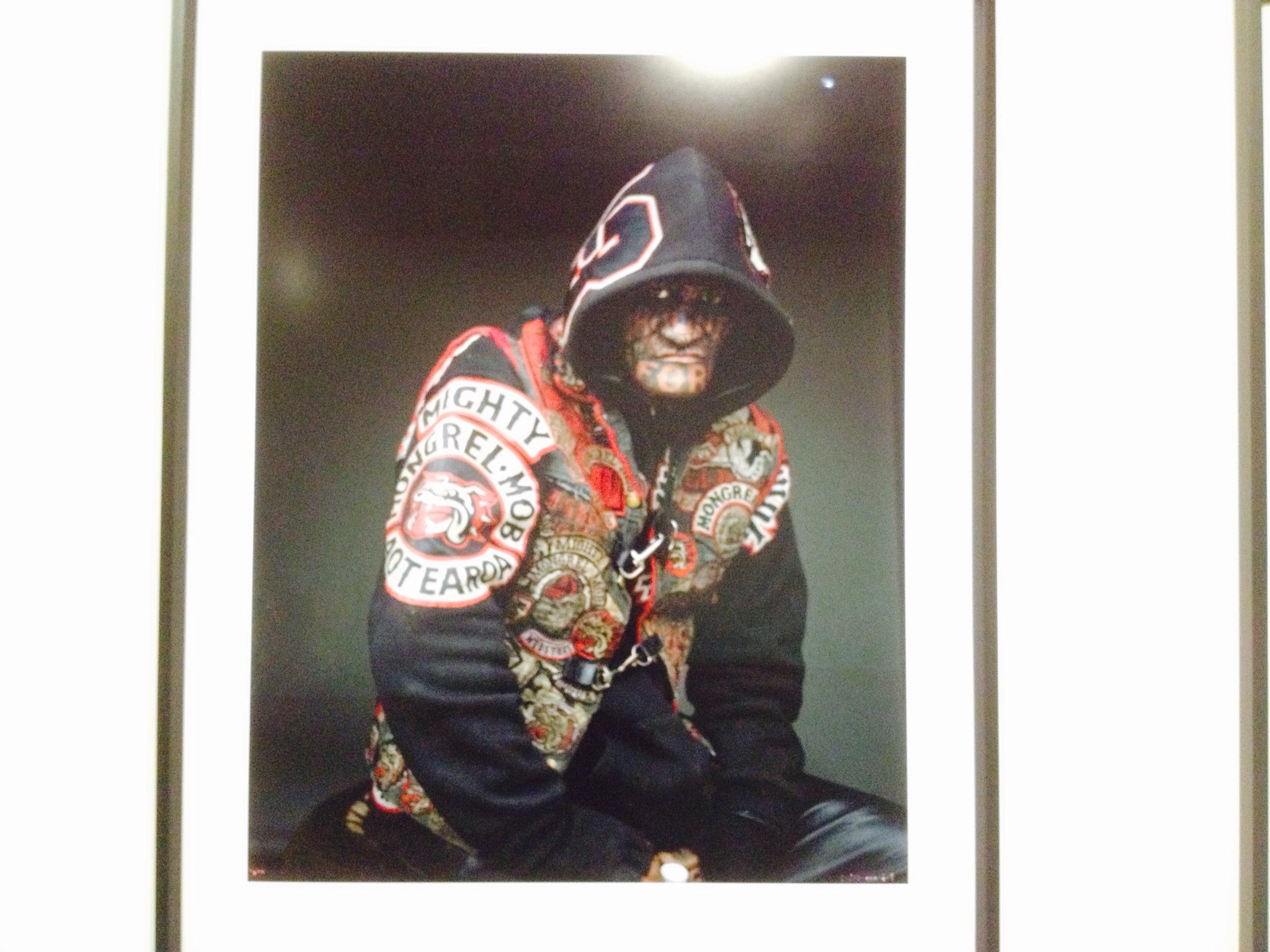
The people we were stopping the night with, Sam and Thelma, live with 4 generations of their family in a former hospital. It’s a warren of corridors and rooms all on one level, stretching hither, thither and over yonder. Sam is well known in New Zealand for his work over many years with the Mongrel Mob, a hard as nails group whose gang members make up over 10% of the entire New Zealand prison population at the moment. Sam works with groups of gang members who want to get back on the straight and narrow often having been through rehab and has an amazing attitude to life and to restoration and to working with people who have been cast out from society and looked on with equal measures of fear and loathing.

(One of the members of the Mongrel mob)

Sam and Thelma have, for decades now, run an open door policy and welcomed in all sorts. Living with them, befriending them – seeing lives turned around and others wandering off in a destructive direction. Knowing jubilation and heartbreak – seeing hospitality and trust at times ripped up and crushed and yet offering more with an open hand and open heart. We spent the evening talking with Sam about his whole philosophy of how he sees his Christian mission. It is very hard to fault what he does and why he does it – and it is immensely challenging.

He and Thelma stand where most people would be far too concerned for their own comfort to stand. They offer a listening voice, practical help, acceptance, time and have gone without much while reaching out to thieves, addicts and murderers. He has a bunch of the Mongrel Mob living next door to him in a house he secured for that very purpose. Christ can be seen in people of many different shapes and sizes: he can definitely be seen in a certain big 20+ stone Maori called Sam.
The final leg of our three day hitch-hike came in the rain the next morning when a half hour (much of which was spent singing and dancing to songs with rain in them) wait led to someone taking pity on us and taking us a few hundred km closer to our goal. from there it was but a two minute wait for the final lift right down to Waikanae, the closest town to the “in the middle of nowhere” community in which we’ll be staying for 4 weeks.
Zig zagging from Auckland to just north of Wellington over three days, 8 lifts and an average wait time of under 9 minutes per lift. Lots of interesting people and stories. Hitching is the way to travel in N Z.

Tasmania – comfort, convicts, compliments…

Comfort. That’s a lovely word, isn’t it? Comfort. What things do you associate with it I wonder. Granny’s all enfolding hugs where, as a child, you’re lost to the world in a heady wave of lavender oil and the colour purple. Or a big mug of steaming soup beside a raging fire on a winter’s evening. A big, fluffy bath towel. No – bath sheet – they’re bigger.

That’ll do for starters – granny’s hugs, big soup mugs, fluffy towel. Definitely things of comfort. 

I’ll tell you what comfort is not. Comfort is definitely not two nearly 50 year olds sharing a thin single mattress that’s laid out in the back of an old station wagon in a lay by next to the main road on the East coast of Tasmania. 

We’re in Tasmania. And that’s wonderful. We’re sleeping in a car. And that’s — uncomfortable! 

When you’re of an age where you have got wonderfully well used to your own, old, familiar bed. And if you’re the sort of person who, when you set out round the world, seriously consider if there is room in your one bag to fit your three pillows from your own, old, familiar bed. And then you’re lying in the back of a car on the very edge of Tasmania and count up that you’ve had 22 different beds since leaving the UK just 9 weeks ago. And now you’re sleeping in a car and your body is adopting positions that God probably didn’t have in mind when he designed them.

In the middle of the night I was a little concerned to realise that I couldn’t feel my legs. Nor my left arm. Nor the left side of my face. Fearing I’d suffered a stroke it was a relief when I discovered that I couldn’t feel the car door either, nor the roof. I couldn’t feel anything because my fingers had gone totally numb. I bashed my anaesthetised hand against the car door in amusement until it woke Ella who thought we might be being attacked. 

If you do have to sleep in a car, at least this one is cool. It’s a very beaten up station wagon with dents and dings all over: war wounds from run ins with bush life and wildlife. It has bits hanging off it and its spare tyre is pretty much just as useful as mine. The car is old and full of character. This car is what Tommy Lee Jones would look like if he was turned into a Mitsubishi.

We’d had two nights in an AirB&B in Hobart, so this was to help balance the budget.

And it has its compensations – we awoke looking out over probably the Indian or the Pacific Ocean. Almost certainly one of them, or possibly the Tasman Sea. Geography is not my strongpoint. Anyway, it was a long beach, a lot of water and very pretty. Looking out of the other window there was a highway with trucks rumbling down it.


We’ll have to find out some time if it’s legal to spend the night in a lay by in Australia. But for now I’d rather rely on a healthy dose of ignorance. Ignorance is, after all, bliss – and it’s also cheaper than knowledge sometimes.

It wouldn’t surprise me if it was illegal, as Australians seem obsessed with laws. I’ve never seen anywhere with so many signs telling you what you can’t do.

And this doesn’t surprise me as modern Australia was invented by convicts, so they were used to having lots of rules.

On our way down to Hobart we stopped in a place pretty much in the middle of Tasmania called Campbell Town. One of the features of the town is the long lines of bricks set into the pavement and stretching either side of the main street. On each brick is engraved the name of a convict sent out from the UK, it gives their age, their crime and their sentence, and often one line to include any subsequent detail known about their later life. Reading them was humbling and sobering. 7 years for a 14 year old boy for stealing bread. Life imprisonment for a 22 year old for burglary. Sarah Brame, age 23, stole 2 brooches, sentenced to 14 years. She was shipped over with her 2 daughters. 

Many thousands of convicts came to Tasmania to serve their sentence. To the South East of the island, on the end of what might be an isthmus (spell check hasn’t objected to that so it might be the word I’m thinking of) anyway, a lump of land connected to the mainland by a narrow strip less than 100m wide is the site of Port Arthur, where we spent the day. It was set up in the 19th century as a prison and housed over a thousand convicts at the height of its popularity. A dumping ground for the overflowing prisons of the UK – conditions were often brutal and escape was infrequent.

One of the documented escape attempts involved a prisoner getting as far as the narrow stretch of land just mentioned (called Fisheagle Neck) which, as it was effectively the only way off the peninsula and was easy to guard, had a permanent group of soldiers stationed there. Our intrepid escapee had come across a dead kangaroo, skinned it and sort of climbed into the skin and then, just as night fell he hopped past the guard post and off down the narrow strip towards the mainland. It was an excellent plan given the fading light and the soldiers’ lack of intimate knowledge of kangaroos. 

However, they were hungry. They fancied a steak. And there was a pretty slow moving meal hopping away from them. One of the soldiers ran after the kangaroo and raised his gun. History didn’t relate exactly what the soldier thought when the kangaroo screamed: “Don’t shoot!” and proceeded to skin itself. 

Although, if the guards were anything like the Tasmanians of today, they would probably have congratulated the prisoner on his escape attempt: “Truly excellent escape attempt Mr Prisoner. Absolutely awesome try!” for Tasmanians, we have discovered, are the most wildly enthusiastically encouraging people on the planet. Just ridiculously so. We all know that the first words an Australian baby speaks are “No worries” – and continues having to say it at least 8 times an hour for the rest of their life. But Tasmanians combine that with over the top encouragement. For example – I conduct a simple exchange at the local supermarket. I place my purchases on the conveyor belt – the assistant beeps them, I hand over cash. “Well done. Outstanding job!” comes booming out from him. I, being British, assume he’s being sarcastic. Look for signs of irony or even mild contempt. No. Pure unadulterated encouraging positivity is dripping down his countenance and all over his counter. And this is magnified all over the island. 

“Way to go!” upon my achieving the impressive feat of buying a newspaper. “Aw well done, beautiful job!” on Ella totally buying a bus ticket. 

I’m not sure how they would react to our doing something actually truly clever: maybe their heads explode.

We mentioned this trait to a couple with whom we’re staying and they laughed it off saying that they hadn’t ever noticed but were then amused when we pointed out 5 occasions they went on to do exactly that during the meal. It must just be so ingrained in their psyche that it becomes unconscious habit.

Australians certainly seem a lot happier in general than Brits. Maybe it’s that they feel so amazingly affirmed when completing even the simplest task.

I think they should change their national anthem and have instead the song from the Lego Movie. It would be brilliant to see at the medal ceremony at the Olympics, or before a rugby match, or at the state opening of parliament – everyone standing proud and then: “Everything is Awesome, everything is cool when you’re part of a team” blares from the speakers. Who wouldn’t get up and dance along to it? 

This level of constant unremitting encouragement just doesn’t happen in the UK.

I’m still a little suspicious of why the Tasmanians compliment the simplest achievement. Maybe it’s just done to Brits. Maybe they have such a low expectation of us that when we manage to walk and talk at the same time without banging into something they are genuinely thrilled. 

Which is better to be? Typical Tasmanian person complimenting everyone and everything in the same over the top manner, or a Brit who compliments far less frequently but, when it happens, far more meaningfully?      I know full well that a large chunk of my personality that should be devoted to encouraging people, or building them up, is missing. It’s not something I deliberately don’t do – it just doesn’t cross my mind to do it at the time. 

I definitely do not encourage enough. What about you? Do you easily say “well done.”  If you do then, “that’s amazing! Awesome job!”

Should you be a little more Tasmanian?

I think I should.


A night at the Commune……..

(This is a little longer post than usual – and there will be some photos and thoughts appearing soon on the  Photo Gallery page – just so’s you know.)


Oo-err, we left you on a cliff hanger…..   Sorry for all the sleepless nights you’ll have endured – but to continue….

Outside of Sydney – linked to the city by a train track life line lies an innocuous little suburban town with an unprepossessing station. Across the road from the station is a German Social Club. It is the home to, among other things many of which are probably good and lovely, a German folk choir – and we had been invited to hear them rehearsing, and following the rehearsal to return with our Couch Surfing host to his “paradise” on earth.

For those of you for whom the term “couch surfing” is new and merely sounds like something doomed to failure no matter how Australian and macho the person surfing with a couch might be, Couch Surfing is the term given to an internet based initiative whereby people who have a spare room, or a spare couch, or a spare floor space which they are happy to have someone use for the night at no charge, advertise said room/couch/space and people traveling and looking for cheap accommodation can get in touch and see if the potential host is happy/able to host them for a night or two.

When we saw Rowan’s profile on the couch surfing web site it looked “interesting”. He said his ambition was to build the ultimate fairy-tale kingdom with a new community free from the constraints and shackles of the modern world. A self-sufficient community living among nature.

Well, you can’t pass up an opportunity like that, can you?

We had exchanged a few emails and arranged to go and stay for a few nights. He told us that he was singing in a German folk choir on Wednesday evening and if we could get to the venue he would give us a lift back to his home/community from there.

So, that’s how we came to be sitting amongst a misshapen mixture of Germans, Austrians, French and Brits on a Wednesday evening in an innocuous Sydney suburb.

I don’t exactly pride myself in this ability – but I don’t mind saying I am pretty good at not laughing at someone or something when it’s not appropriate. This comes in handy in my line of work. And it came in handy several times during an evening in which we felt like we had drifted into a parallel universe at times. 

The choir were the kind that any conductor would find a tad challenging. No one could fault their enthusiasm. 

One might find fault in their pitch, tone, volume, musical interpretation, proclivity to reading novels at the same time as singing, musical interpretation – maybe. But you could not fault their enthusiasm.

They practised for 2 hours. 

It wasn’t enough.

But, finally and thankfully it ended and we piled into the back of a small 2 door car along with Rowan, Rowan’s dad Manfred, Rowan’s Canadian girlfriend and their dog. 

To take a brief step back: when we arrived at the singing club we were early and the first person there was Manfred – and during the first ten minutes of conversation we had with him, as he sat reading “A Jewish Guide to Adultery”, he had only really referenced sex, and the words for toilet in each language he knew. He looked to be in his late 80s so it’s probably good that he had a hobby. The only thing we ever learned about Manfred’s wife was that she had twice accidentally run over their dogs.

On the journey back Rowan decided it would be best if he unleashed his personal philosophy of life onto us. 

He began with: “My plan is to build a brand new civilisation! Nothing less!” He proceeded to drive at break-neck speed, looking occasionally at the road but mainly, and very scarily, back over his shoulder at us, studying our reactions to his “revelations”. 

Basically, he sees himself as a sort of saviour and prophet and teacher. He operates on a higher plane than anyone else and has been impregnated with knowledge of how we are exactly halfway through a 26,000 year cycle before the end of the earth (currently in a 40 year changeover period between the two 13,000 year “halves” and we are currently passing through the blue light of the sun in its binary star system which NASA know all about but refuse to tell us. It’s illegal to use most of our brain and all governments and monetary systems are tools of total suppression from which we should free ourselves. 

So, you see, some of what he said made sense. But most of it was stark staring crazy. And, disappointingly, it was just run of the mill, boring sort of crazy. If he had been merely extremely eccentric, that would be OK, but he was just unhinged.

Apart from anything else he was wearing a Tyrolian cap and short shorts and he couldn’t have looked more German if you had stuck a dachshund on his head and covered him in sauerkraut. I like Germans – but this one did not do the rest of them any favours. 

The community he is hoping to build is nothing more than a bit of a tax dodge and his permanent followers number approximately zero. I have to approximate because I’m not sure his girlfriend is a follower as she goes away in a few months when her visa runs out and she didn’t seem to follow what he was saying. 

I don’t think any of us followed what he was saying. Lots about the well trodden prophecy from the Mayans (they didn’t get 2012 wrong so much as it was speaking about him, apparently).

The journey flew by. At least, the countryside flew by. He drives like he talks; rapidly and with no concern for others. I have only ever been truly scared by two drivers: one of the guys in the rugby club I played for when we were in Scotland who was known as “The Pope” – not because he was particularly religious, but because when you had been driven in a car by him you kissed the ground when you finally got out. The Pope was the first truly scary driver – Rowan was the second. Also, it being a two door car, we couldn’t even jump out on the few occasions he slowed down. 

I also made the mistake of arguing with him. 

There are several types of people you should not argue with. Gunmen, airport security guards, your mother. And some people it is truly pointless arguing with. Drunks and certifiably mad people being two. Applying logic against his rant against religion was like handing a lettuce leaf to a charging lion and hoping it would make him vegetarian. 

When we arrived at Rowan’s commune and the car finally became unfamiliarly stationary, we emerged into his “wonderland”. A couple of portacabins, a mobile home, a tepee, a communal area of covered seating attached to a lean-to housing a kitchen zone and a couple of shed-like dwellings placed next to one another with what looked like doorways linking them. All this within a large, sloping area of countryside with a river running through it.

We were told that we would be in the tepee. On unlashing the door flap we were faced with spartan accommodation. Which was fine. The bed was strangely moist for such a warm night – we left it to hopefully air for a while and went to the communal seating area to see who our fellow inmates might be. 

There were 6 or 7 gap year students there that night, passing through, and an older guy from Wigan who was “fighting the system” which, it transpired, meant he lived with his girlfriend and they both claimed unemployment benefit, child benefit for her child and child maintenance from the ex-husband. This way, he said, he was avoiding “putting back into the system”. Ella asked him if he had thought about trying to live a self sufficient life and he looked dismayed saying: “That’s really hard work! Growing food and stuff, I’d rather not do anything at all and live out my ideology.” He was not pleasant to talk to.

The students were mainly European and seemed to stay there for between one night and a couple of weeks, occasionally helping to  build new shelters and generally living rent free and enjoying freedom from parental rules. They seemed a nice bunch. None of them were devotees of Rowan’s “vision”.

We were thankful that the saviour had turned in for the night having struck out on his unsubtle hints about the benefits of free love. (Having asked Ella and me if we were ‘together’ or just friends and being told we’ve been happily married for 29 years looked Ella in the eye and slimed: “that is such a pity for all the men out there.” Not a good line. If you think it is, ask a woman and listen closely to the answer…..) His father did appear, uttered some probably unintentional racist comments about some of those gathered and went off to check that none of the dogs had been run over. Ella and I went to the tepee to compare levels of unease. 

Sleep came easily.

To Sleeping Beauty in the fairy story. 

To us – it didn’t, really. 

Ella and I weighed up our options. They seemed to consist of: 

A.) stay on site and hide from people who were wanting some free love and/or might for all we knew get some crazy ideas and go all Jim Jones on us.

B.) bravely and heroically run away.

C.) evangelise our host with the news of an altogether more complete saviour. 

After a sleepless night we went for B.

And so  next morning, in the 40 degree heat of a cloudless day we grabbed our (thankfully, singular) bags and sneaked out of the compound to hitch a ride to the nearest town.

Everyone knows Aussies are friendly and helpful and likely to stop and give lifts to people. 

Well then, everyone….. you’re wrong.

After an overly long passage of walking and earnestly waving our thumbs at anyone who passed, (our admittedly unpolished technique included, at times, exuberant dancing and using a variety of “winning smiles”, all to no avail) we were getting a tad disappointed. Also a tad dehydrated. We were in the middle of nowhere somewhere out near the Blue Mountains. We weren’t definitely certain we were even going in the right direction for the nearest town. Cars, when they appeared, were not stopping: most seemed to actually speed up when they saw us, and a few drivers gave little waves which might have meant “we’re turning off soon so we’re probably no use to you” or more likely “I don’t want to let any hot air in as the air con is having to work overtime to keep me deliciously cool in here”. 

I was, it must be said, getting a little ungenerous in my thoughts by this stage.

Luckily I had picked as my hitching buddy someone who, when she sees an old man in the distance on a ride on lawnmower cutting the grass at the back of his farmhouse will jump the fence and chase him to ask for water and directions.

Having nearly scared the life out of him (he was old, heading away from us and hadn’t expected anyone to be running after him out here in the middle of the day in the middle of his private land) he was kind enough to take us into his entirely ancient tumbledown farmhouse and offer a mug of water from the sink, next to which his teeth sat (“darned things need grinding down: still don’t fit right”).

He told us that it would be an “awful long” walk into town and then he wonderfully and heroically offered us a lift, though it would be a bit of a squeeze. The only transport in evidence in the yard was the ride on mower but even if he had meant riding all the way on that we would still have said yes please. As it was he took us to an old barn and drove out a beat up pick up truck into which we happily squeezed and he drove us into the nearest town. It took about 20 minutes so I’m not sure what that would have been in hot on-foot minutes.

We took the next train out of town – which, thankfully, was heading into Sydney and we spent the afternoon at the harbour, generally giving thanks that we were alive and wondering where we should spend the night as we’d been due to stay on the commune for a few days and hadn’t made other plans. 

We walked up to an area called The Rocks, not far from the harbour, and booked into the youth hostel there. With our youthful looks and ready cash we secured the last available room for that evening, according to the receptionist. I doubt that there are many better youth hostel views than from the rooftop terrace of the Sydney YHA building – overlooking the harbour, bridge and Opera House. It looked good in the day – even better at night.

We decided to try a little high-end Aussie dining that evening and so went to The Australian Bar and ate kangaroo and emu pizza.

Happy to have done it.

Happy not to do it again.

We spent the next day on the quayside at Sydney Harbour. 

A huge cruise liner had parked and disgorged hundreds of happy cruisers and a sponsored walk by several hundred foursomes was making its way round the quay and it all added to the buzz of life in one of the world’s iconic venues. 

As we sat and sipped our credit-card-worrying coffees and enjoyed seeing all the life passing by with all the stories they held, the snippets of conversations heard, we reflected on the disappointment of the trip to the commune. We’d hoped for a quirkiness, an insightful lifestyle philosophy, something to make us think deeply, but instead got a worryingly sleepless night in an airless wigwam in the stomping ground of an unwanted self-proclaimed messiah.

I have spared the dear reader from the majority of the rantings of Rowan for the sake of brevity and sanity and knowing it’s often hard enough to follow my sentences anyway – but I have to admit that throughout his ranting about the church and how it has acted through the ages (though I’d happily but fruitlessly argue with him over his interpretation of who he thinks lies behind it all), his attack on religion and religiosity was probably his most cogent line of thought.

I wonder how people responded when Christ said he was the saviour and stated that history would pivot around his incarnation. For those hearing it fresh it must have only left the choice of madman or messiah. Having experienced the real thing, and a Germanic/Australian mimic, I’m happy to stay where I am.

I’m not joining the commune.


Johannesburg to Sydney

The flight from Johannesburg to Sydney was our first encounter with Qantas airlines. I only know them from adverts in my youth which featured Dame Edna and a koala bear. 


The adverts didn’t say anything about allowing you a much lower weight allowance for your carry on bags than any more civilised carrier. As we only have carry on bags and no luggage going in the hold it doesn’t seem overly fair that an overly-zealous book-in lady decided to weigh our bags when we checked in. 


Ella was, of course, just under her 7 kg allowance as she had bothered to read the blurb and had come prepared in case they adhered to it. My bag was a mere 13 kg. (It seems to have got heavier as we’re travelling but I really don’t know how as I don’t think there’s any more in it.)


The lady told me I would have to get my bag down to 7 kg. Ella tried not to give me an “I told you so” look. I’m not sure she fully succeeded. I helpfully made the point to the lady that if I checked my bag into the hold it would be free and would also have the benefit of the added excitement of wondering where it would end up when we were looking forlornly at an empty baggage carousel in Sydney. She reminded me that for carry-on the weight restriction was 7 kg and could I please make my bag lighter.


There then followed a wonderfully pointless exercise in moving things from inside the bag to outside the bag in order to make the bag weigh less just so that I could put all the things back into the bag as soon as we were through the check in. So, out came a sweat shirt that I tied round my waist. Slung another top over my shoulder. I stuffed tee shirts and shirts into the arms of my jacket and carried that over my arm (although this made the arms of the jacket stick out as they were stuffed solid and it looked like I was carrying a torso). Bag back on scales – just under 8 kilos. Need to get to 7. I asked her if there was a bin into which I could throw my least wearable shoes and she said: “oh, don’t do that, just put them on top of the bag – it doesn’t really matter that much.”


Through check in. 20 yards down the corridor: stop, stuff everything back into bag. Proceed to boarding gate.


We had booked the rearmost seats on the plane. We thought they looked like a good choice when we had selected them during the online booking process because there were two of them alone, together – and it looked from the diagram that you’d get a bit more space and wouldn’t have anyone pushing past you to get out to the loos. And the theory was good. You did get a little bit more room. 


Well done us, we thought. 


Til we were way out over the ocean and at the mercy of the winds in the roaring forties (if that’s where they are, I think they are) and every single one of them roared.  


A whole torrent of turbulence that threw the plane around for what seemed like an age. The heavy food serving trolley went flying during one severe dip and fell onto one of the passengers. Fortunately the arm-guard took the brunt of it or his legs would have been squashed. As it was the stewardess who hadn’t secured it properly had egg on her face and the passenger in seat 74E had egg absolutely everywhere.


Way back in the tail we seemed to be suffering the worst of it and in recognition of that the chief steward came along during a slightly calmer moment and asked if we would like to move closer to the middle of the plane for the remainder of the journey. Promotion to the dizzy heights of Premier Economy! Only a flapping curtain’s width from Business Class!  Near the wings – a lot smoother ride – with far more fancy seats and stuff to play with and way superior plastic cutlery with which to breakfast.


We felt like royalty. 


Albeit slightly minor royalty from an obscure East European country with too many consonants.


Touching down in Australia we had jumped forward 9 hours and although we hadn’t slept at all and to us it was 5.30 in the morning it was actually mid afternoon in sunny Sydney.


Our hosts for the first night were Steve and Grace. Grace is Korean and we were taken that evening to an amazing restaurant where we battled with chopsticks and had a traditional Korean spread of about 20 small dishes of food which gave some palate punching combinations of flavours. We sat next to some black-belt chop stickers who made us feel a little inadequate. Strange cabbage stuff that’s normally stored underground to keep it tasting funny and what can best be described as a crab which had recently stepped on a land mine were two of the stand-outs. Very tasty. 


We spent the next morning exploring Sydney and the early afternoon sleeping in a park trying to catch up on the jet lag.


Must mention the exceptionally excellent trains they have – double deckers with air conditioning and seats that you can move to face both ways! The upright back section has cushioning on both sides and it pivots (the seat bit you sit on stays where it is) and you move the upright to instantly turn a three seater bench from forward facing to backward facing. Handy indeed if you are the sort of person who likes to travel facing forward. The trains are clean, air conditioned (did I mention that already – and are you listening Transport for London), with excellent communications and less than half the price of London Underground too.


Anyway, that afternoon we embarked on what will most likely be one of the most scary and memorable evenings of our whole trip…… 


Johannesburg – the Kruger National Park

Back in the relative safety of Johannesburg (relative safety being defined by the fact that the people we’re staying with in Jo’berg know less people who have been killed than the people we stayed with in Zimbabwe) it’s hard to miss he fact that apart from the sprawling shanty towns, every other property is surrounded by electrified fences, high walls, razor wire and dogs.


As the town was not dangerous enough, we were taken on a camping safari to the Kruger National Park. (Many more things that could kill you.)


The Kruger National Park is a huge area of nearly 20,000 square km to the northeast of South Africa, criss-crossed occasionally by tarmac roads and sand roads that you drive along through mainly shrub land and grassland and alongside rivers. There are occasional campsites which are fenced to keep the animals out, giving a safe haven for the night – with the roar of lions and the scavenging of hyenas at the fence giving you something to count as you drift off to sleep…..


……For an hour or two before getting up at crazy o’clock in the morning to be in the camper van and in the queue at the exit gate before 05.30am. Stephan was, well, let’s just say “keen” to be in the first 2 or 3 cars in the queue because the gates open on the dot at 5.30 and you really want to be the first car on one of the roads leading out through the park to have the best chance to see the lions, leopards and wild dogs that often walk the roads early morning, enjoying the feel of the retained roadheat from the previous day and avoiding the dewy grass. 


So, if you’re, let’s say, third in the queue on the first morning, the done thing (I offer this Kruger Park etiquette lesson free of charge to you) is to drive out after the first few cars shouting “turn off left, turn off left” to get rid of the first one and then pleading with the next one to carry on straight because the road we really wanted to go down is a few km from camp and off to the right. Worked like a charm.


Having successfully rid yourselves of the hindrance of cars ahead of you (it’s very bad form to overtake another person unless they are stopped at the side of the road and if they are stopped you’re likely to want to stop too because they’ll only be stopped because there’s something to see), you are free to enjoy an unencumbered view of the road ahead as you embark on a futile game of “leopard spotting”. Let’s face it, there could have been a troupe of 9 leopards in day-glo spandex leotards doing a Buzby Berkley routine and I wouldn’t have seen it at 5.30 in the morning.


However, over the 4 incredible days we spent in this amazing place we did see 42 different species including the Big 5, so named because they were the most prized hunting trophies in days gone by: loads of elephants, 4 different pairs and triplets of rhino, several groups of lions including one lucky chap and his harem of 10 ladies who were all relaxing by a water hole when a large bull elephant decided to walk through them and wanted them to move out of his way. They obliged. Quite a few buffalo and 2 leopards (or rather one leopard, twice – though not in the early morning). 


Apart from the big 5, favourites were probably the packs of African wild dogs we saw sleeping a couple of feet from us on several occasions – one or two would then get up and dopily meander about and flop down again looking incredibly docile and tame, a million miles away from the extraordinary raw power and aggression they show when they hunt with military precision in formation, running their prey, up to buffalo size, into the ground or taking it in turns to take chunks out of their moving dinner as they run alongside. 


And my personal favourite: one of nature’s real thugs – the honey badger. Nearly a metre long with a lovely two-toned light and dark grey coat. Prefers to attack rather than defend and will do so with no provocation. It has no real predators because nothing is stupid enough to take it on.


Apart from having a worse than skunk like excretion from the back end, its powerful teeth and claws do a good job at the front end. It has a tough, loose skin which, if a larger animal were daft enough to get its jaws around it, enables the honey badger to twist and give a good smack to anyone who’s grabbed it – same principle as a Glaswegian in a shell-suit, really.


Why are honey badgers so aggressive? I don’t know. Possibly it’s down to pure embarrassment over its name.


A honey badger sounds like he or she should be chums with Winnie the Pooh…..


Chapter 7. In which Winnie the Pooh meets the Honey badger.


The sun beamed its happy rays over 100 Acre Wood as Winnie the Pooh awoke, did a few uppy and downy exercises while thinking of his favourite jar of honey and then sallied forth, skipping off toward Piglet’s house. Along the way, whom should he meet but a 90 cm long block of muscle wrapped in a loosely fitting two-toned grey pelt.


“Hullo,” said Winnie, the bear with very little brain. “I am Winnie the Pooh. I’ve not seen you around here before. Who are you?”


“I’m a honey badger.” 


Winnie was everso exited. “A hunny badger! ” he exclaimed. A badger made of hunny? Hunny is my very favourite thing. I am going to see if you taste of hunny.”


“I don’t think so, pal!”


Chapter 8. In which Piglet and Roo stumble into a scene of unimaginable slaughter.


Chapter 9. In which Eeyore hits the anti-depressants pretty hard.


Chapter 10. In which Christopher Robin gets a new best friend. 


If Winnie the Pooh met a honey badger – it would not go well for the bear with very little brain. Honey Badger could take on Winnie, Tigger, Eeyore and the heffalump with one arm tied behind its back. Christopher Robin would need more than a couple of plasters and a visit to nursey in sick bay. 


I shall not be trying to take a honey badger home in my bag, but there were a number of other animals we saw that looked like they would have made awesome pets. 


The usual patten of the day was to drive from 5.30 am to about 11.30 am, stopping somewhere to cook a breakfast. Then return to camp and rest during the worst heat of the day and head out again about 3 til 6.30 when the camp gates close. A braai for supper and then hit the hay between 8 and 9 pm. 


It’s an exhausting, but exhilarating way to see animals in the wild. 


Zimbabwe weekend 3 – a stormy lakeside retreat

Weekend 3 in Zimbabwe. A stormy lakeside weekend retreat.


The sky rumbled like rocks in an oil drum and roared like a wounded lion and the rain attacked the earth with breathless aggression.


I’ve not encountered a storm of such full-sky intensity. And this was not even particularly brutal by African standards. 


Proper stormy stuff.


We were staying at the weekend retreat of one of Zimbabwe’s wealthiest men (as you do) in an area of the country which is particularly hostile to whites at the moment. (Weren’t told that til we got there!) On a scale of one to dangerous where one is not dangerous at all and dangerous is pretty dangerous, this was by our british standards a 6. The people we were staying with probably thought it a one and a tiny bit, but they also told us fairly often of people they knew who had been savagely attacked, others killed, one just down the road, another a little way away, another on a neighbouring farm…. I take my hat off to them – I’m sure you develop coping mechanisms for living amid so much loss and frequent stories of danger – and they seem to have developed them very securely. 


Although to our Brit eyes this place was a lot more remote than secure. We reached the “retreat” having travelled the last 40 minutes of the journey down dirt tracks which would have been impassable for anything less mud-loving than the big 4 x 4. So, all in all, a little bit isolated.


Still, at least we had electricity.


Aha – not so fast…


Even the rich fall prey to the increasingly frequent electricity cuts in Zimbabwe – and we spent most of the weekend without power. Add to the mix, the white family who farmed the next door farm had just been told they were being thrown off the land and their farm taken over. 


Only a fraction of the farms are still in white ownership, a far cry from the white ownership of over 70% of the arable land a few years back. Many would be given 24 hours notice to pay off their workers and get off the land. They were not allowed to sell any machinery or stock and could only take personally owned items out of the farmhouse. 


Earlier that week we had stayed with a family who had been thrown off the farm they had built up over more than 25 years, and then lost everything overnight when a black Zimbabwean was “given” their farm.


Clearly the former distribution of land was totally wrong and many white farmers had for too long been made very wealthy while their workers remained isolated and poor. The old system was wrong to modern Western eyes, but the iron fisted solution with its nepotism (handing out of farms to the president’s chums), violence (all too often) and the giving of land to people who either just wanted to asset strip what they could, or simply had no knowledge of farming has left many of the once fertile farms overgrown and unproductive. We’ve seen plenty of evidence of that as we’ve been travelling around.


The government’s “solution” has left far more of a problem for the vast majority of Zimbabweans including large numbers of former black farm workers who are no longer able to even earn any kind of a living on the farms because many of them are not being farmed!


I wonder whether Mr Mugabe has ever met the retiring prime minister of Uruguay, Pepe Mujica – who drives around in a beat up old VW Beetle, gives away 90% of his salary to charity and lives in a small apartment with no frills. He’s soon to leave office – his successor is likely to follow his lead and avoid living in the presidential palace too – and the new leader will take over what’s probably the most socially stable country in South America. 


Come to think of it, I wonder if David Cameron has met him? 


Ah well, frying pan, fire …. Off to South Africa next, under Mr Zuma who is doing his best to avoid repaying tens of millions of tax payers’ money he has squandered on extending his private home. 


Zimbabwe weekend 2 – a tobacco farm

It’s a strange, strange feeling being proudly shown around extensive fields of top quality tobacco plants mid-harvest. It has been a really good crop for the farm manager with whom we were staying and his brick barns were full of massive compressed bales of cured leaves waiting to be taken to be sold. It felt odd trying to appreciate a crop whose sole purpose is to shorten lives. He is looking to branch out into potatoes next year: I really hope that takes off – I feel a lot better about potatoes.

There are over 100 black workers who work long, long hours in the searing heat for a wage of one hundred dollars a month. (Zimbabwe’s main currency is US dollars. Currently 100 dollars would be £65). Let’s call it £2 a day. They do get basic housing and electricity in their workers’ village but when we’re sitting on the veranda sipping cold beers and 200 metres away they are surviving on a staple diet of mealie-meal after a long shift in sweltering heat…. It felt awkward.

We attached the speedboat to the new 4 x 4 and drove it down to the lake to do a little recreational fishing. Out on the water we passed some of the locals on the bank, fishing with a little more earnestness.

Sure there are rich and poor in every country of course, but here it felt as though (substituting boat and car for 18th century equivalents perhaps) we might have been back on the cotton plantations.

However, there is one big difference to the way this scene would have looked 20 years ago, say. For today, although the conditions for the workers are the same, the owner of the farm is also black. My white relative is working for him as a farm manager because he has the skills to get the best yield, as he would have done on his parents’ farm had it not been taken from them. A majority of the other stolen farms have not been run so well.

Many Zimbabweans, black and white, have left the country – there are 4 million in South Africa alone.

The black Zimbabweans remaining in Zimbabwe are the poor and the couple of hundred politically and economically protected families that make up the ruling elite. In the words of one ex-pat Zimbabwean now living in South Africa: “They (the ruling elite) have raped and plundered their country and impoverished their people. Almost all the mining resources have been handed over to China with the government ensuring that they are 51% shareholders of everything that comes out the ground. The diamonds they have just stolen. Their contribution is nil and the money made goes to the ruling cabal….. The farms were handed over to the ruling elite and they are in ruins. From an economic perspective you can take the farmers off the land but the skills to work these assets are no longer there…… Sporadic electricity, a collapsing infrastructure, a corrupt government and yet some whites stay. On the surface they enjoy an enviable standard of living but at what cost? What is the risk? Underlying it all is the ever present threat that everything you have can be taken at the stroke of a pen.”

This has happened to some of those in my family. They have started again from scratch and made promising (albeit fragile) futures for themselves. It is a country which is deeply scarred, many of the wounding blows wielded by its own politicians.

I don’t think President Mugabe cares much whether foreigners come into the country – unless it’s to give him money in return for business rights to leach some of the country’s phenomenal natural assets.

With the astonishingly beautiful resources of Victoria Falls, Lake Kariba and some not-too-shabby scenery along the way you would have thought the tourist industry would be forefront in the government’s mind.

And, to lighten the tone a little, having been there I can tell you there is not a fat lot to do as a tourist in Harare. If you log into Trip Advisor and type in “Top Attractions in Harare” the results are a little sparse. Fortunately for us, we could spend lots of time with family. But Harare? Well, it’s not set up for tourists.

However, there’s an exception to most rules and one place which was simply AMAZING is a place called Wild Is Life. It’s a small animal conservation area not far from the airport where they take small groups of people around to fully engage with the wildlife they have there. So, you get to see the lions being fed up close and personal. (Good excuse to show off photos I took – this one of a lion looking at me and, unnervingly, licking his lips!)

IMG_1604

(We were THAT close!). We got to walk with cheetahs, bottle feed giraffes,
stroke a pangalan (one of God’s weirder projects – probably invented on the same day as duck billed platypuses and the blob fish – go on, google “blob fish”, it’s very strange.) Pangalans are a bit like an anteater crossed with a tank. They walk on their back legs with their front paws off the ground, looking like an old (very flexible) man looking for a lost contact lens. Quite rare now – they used to be taken to the head of the tribe to be eaten as this was considered good luck (more for the chief than the pangalan it has to be said). Today, President Mugabe, by decree, owns every pangalan and if you find one you are meant to present it to him. Wild Is Life is thankfully allowed to keep theirs and he has his own keeper who cares for him full time.

IMG_1600

There are lots of animals running pretty free and you also get to meet and greet a little orphan elephant. He and I got on very well and I got to shout things down his trunk.

IMG_1660

It was, all in all, an awesome day of animal encounter

IMG_1566

Zimbabwe, weekend 1. Lake Kariba

Zimbabwe didn’t fit in with the schedule of the round the world ticket we got. The airlines the company uses don’t fly to Zim as part of any package so we had to buy the plane tickets in and out of the country separately. The reason for including Zimbabwe into the travel plans is that we have relatives over here and we’ve never visited them. We really wanted to come, especially as we would be sort of in the neighbourhood.

My uncle emigrated to Rhodesia (as was) about 50 years ago and spent most of his life in the education system, founding schools and teaching and was a headmaster for many years. There are now cousins and second cousins and cousins once or twice removed (I don’t understand all that stuff) in various parts of the country.

I have been fascinated to see what life here is like in a country so little reported on in the UK in recent years but one which has gone through war, huge upheaval, economic meltdown with a peak inflation rate of 11.2 million percent at one stage and where a tiny minority of whites (1 white Zimbabwean to every 1,000 black Zimbabwean) coexist in an often brittle relationship.

On our first weekend in Zim we went up North to Lake Kariba.

IMG_1501-0

(My arty shot of the lake)

Just before we headed lakeward I read from Blighty the ludicrous news of the letter which was sent out by the department of health and insanity in the UK to leading supermarkets asking them to move daffodil flowers and daffodil bulbs away from fruit and veg sections in case people mistake them for onions or Chinese edible plants and try to cook them which can have unfortunate side effects such as dying. (It reminds me of an unfortunate mistake I once made in Tesco when their stationery aisle was placed close to the meat section and I cooked a packet of felt tip pens thinking they were sausages.)

I think that if people need to be told not to eat daffodil bulbs they are probably beyond help.

I would shudder to read a list of all the things we have been warned about in the UK that are bad for you, many of which will change every few years or so to contradict what you were told before.

It puts things into a new perspective when you come to a place where there are all sorts of things are a lot more dangerous than daffodil bulbs!

Namely, Lake Kariba – it makes Windermere look a bit puddle-like. It’s the world’s largest man made lake – lies between Zimbabwe and Zambia – it’s over 200 km long and up to 40 km wide in parts. It’s big and it’s beautiful.

And it’s dangerous! Positively packed full of things that want to kill you. Lots of hippos and more crocodiles than you could shake a stick at (while screaming: “Go away!” Loudly).

In England the most dangerous thing you’ll find in a lake is a shopping trolley.

People are regularly “taken” by crocodiles here. The last one (from the small jetty where we got on and off our little boat each day) was just a few weeks ago. The jetty is about 8 foot by 5 foot and a foot above the water. The water was murky brown so you couldn’t see what was lurking beneath and it left us feeling a little bit English – really wanting to get off it as quickly as possible but also having a desperate urge to form a slow moving queue.

We saw locals sitting, fishing, on the very edge of the lake with crocodiles a few metres away from them.

We sailed partway up “crocodile alley” which is a river running into the lake with a shedload of crocodiles and hippos. Think Roger Moore in Live and Let Die in the scene on the little island at the crocodile farm but with hippos added into the mix. We sailed past a group of 14 hippo adults and babies wallowing about but when a few of the adults started submerging and heading our way the anxious vibes we were giving off were picked up by Cap’n Mike and we high tailed it back to wider water.

We spent two seriously hot mornings fishing for bream with a fair amount of success and had a wonderful experience on the second evening when sitting on the front lawn and looked up to see an adult hippo grazing just 20 feet from us.

Traveling back from Kariba we slammed to a halt 20 feet from two elephants, grazing at the side of the road. We took a few photos and were saying lots of lovely things about how magnificent they were and how amazing it was to see them in the wild, just a few feet away, when a couple of cars and a pickup truck roared past at high speed – there were about 8 people in the back of the truck who were yelling at the elephants as they flew by which was crazily irresponsible: it was us who would be left to deal with a couple of distressed and stroppy nellies. Mike figured that reversing away from them would be a very good idea but the numpty in the car behind was frozen to the spot and wouldn’t move. Only option left was to try to get past the elephants before they charged.

I’m not sure whether it’s a good or bad thing that Mike’s truck is a big silver Toyota 4 x 4 which, if it had a trunk and big floppy ears would probably pass muster as a slightly under-height pachyderm, but these two very real elephants looked mighty peeved. I was videoing the scene on my phone, as there seemed nothing else to do other than scream and pray, and I have a great shot of the elephant nearest us stamping and trumpeting and generally being pretty angry and the second one, quieter (it’s the quiet ones you’ve got to watch, apparently) running at us as we race past and miss it by a metre.

There are definitely bits of Africa that are out to kill us.

You can forgive it a few assassination attempts as it gives such a lot in return. Lake Kariba is just stunning. With majestic fish eagles and herons and kingfishers flying around and elephants, warthog, zebra, hippos and crocodiles all spotted (zebra, striped) on one day. Huge skies – stunning sunsets. It’s easy there to think thankful thoughts of creation and creator.

Zimbabwe – part 1

As I write this we are back in South Africa having spent 3 amazing weeks in Zimbabwe. Apologies for the lack of posts in the last fortnight but we have been without electricity fairly often and without WiFi for most of the stay.

And it’s difficult to know what to write about our views of a country which has had a recent history so different to ours and has a view of how whites employ backs which relies on buying in to understanding how things were in the past in order to accept how things now are: where black farm workers labour long and hard for £2 a day and the question posed to a group of white ladies as to whether it would be comprehendible to employ a white maid rather than a black one was met with absolute incredulity.

Also, I don’t want to be disingenuous to those who showed us such wonderful and generous hospitality – but who, in the majority, have views of black and white which are massively different to ours. Anything I write is from a very british perspective.

Firstly, mentioning as we will be in a little while,100 dollar bills, it would be good to stumble across some as the Zimbabwean authorities like to take lots off you.

When we flew in to Zimbabwe we got stung for 110 US dollars for entry visas. When we were visiting various places in Zimbabwe we got charged up to 5 times the local entry price for being British. Admittedly, at some of the places where they tried it we avoided the extortionate hike by pretending to be Zimbabwean. We managed this by not talking – for even my best impersonation would not have passed muster – even saying “shame” and “lekker” four times in every sentence wouldn’t totally fool the locals methinks. Then, at the airport on the way out of the country, we were stopped at the security desk and told we had to pay an exit tax. Another 100 US dollars. So we pay ‘entry’ tax, we pay “being here and visiting things’ taxes and ‘having the temerity to leave’ tax.

At the airport, on being told we had to pay the “exit tax” I didn’t voice my disbelief and displeasure nearly as colourfully and vernaculary as the guy in front of me as I feared the next conversation the guards had with me might well go along the lines of……

Thank you for paying the 100 dollars exit tax which I have pleasure in taking from you whilst not giving you a receipt. And while I have you here, may I ask: Did you breathe whilst you were staying in Zimbabwe sir?
Breathe?
Yes, that is correct, did you breathe at all?
Yes. I did. I felt it was necessary on occasion.
Well then sir, there is the Inhalation Tax to pay. That’ll be ten dollars, please.
What? For breathing in?
Yes sir. You were breathing Zimbabwean air which is the president”s air. He likes to have the air first. If you breathe it before him you must pay the tax.
That’s not fair.
No, but you are. Now then, may I solicitously enquire whether you then held your breath during your entire stay, sir?
No, I can’t say I did.
So you breathed out then?
Of course.
Ahh, well then there is the Exhalation Levy to pay too.
Which is?
5 dollars.
Half the price of the inhalation tax.
Special offer.
Well, fifteen dollars for being allowed to breathe is reasonable, I suppose: it”s definitely worth it for all the beautiful scenery I saw.
Ahh, did you look at the scenery, sir?
Yes. A lot of it was beautiful.
Then you’re liable to the Looking At Things Tax.
You’re trying to tell me there’s a tax for looking at things?
Indeed sir, ohh, and I hope for your sake you didn’t use both eyes……. And did you enjoy the views?
How much is the tax if I did?
40 dollars.
And if I didn’t?
40 dollars.
I don’t understand.
Don’t worry sir, there’s an Incomprehensible Tax which covers that…. If you’d kindly open your wallet you can leave the rest to me.

As it was, I paid the ridiculous 100 dollar exit tax and sadly, left a beautiful country with a sour taste in the mouth. Zimbabwe really doesn’t seem to care much about tourists.

Shame.

That word “shame” is an awesome Zimbabwean word (South Africans use it too, but Zim uses it much more) which seems to have an infinite number of uses. It can mean something is bad, good, happy, sad, obvious, mysterious – anything really.

I didn’t dare use it because I had an unnerving feeling I would use it totally wrong – which is strange because nowhere really seems to be the wrong place for it to go in any sentence as far as I can tell.

The following would be an entirely normal conversation between two Zimbabweans.

Hi.
Shame.
Shame.
I went to the shops this morning.
Shame. What did you get?
Trousers.
Shame.
Then I couldn’t find my car keys. Shame.
Shame.
But then I found them.
Shame.
Shame. And I found a 100 dollar bill.
Shame.
Shame.

There really is nowhere it can’t go and yet I know that if I said it even once it would sound entirely wrong.
A Zimbabwean: “Hi, Jon, would you like some eggs?”
Me: “Shame.”
(Frosty silence as they look at me like I’d just kicked their kitten).
So I stayed resolutely English and used words like “sandals” (they call them slops), “trainers” (takkies), pick up trucks (bukkies) MOT (they don’t have them – if you can get your car to go, that’s good enough) and “jolly good” (lekker).

Zimbabwe is a beautiful land – if she were a literary character she would be Miss Havisham.