Monthly Archives: May 2015

Lord Of The Rings

The only real time we spent outside of Ngatiawa during the month was to drop into Wellington (which is apparently, officially the windiest city in the world, – and I can believe it) so that Ella and I could make wedding rings for one another. 29 years ago we had no money at all and so all we could afford were really thin, cheap gold rings and mine had got more and more worn over time until at the New Year it decided to end its life as a ring by snapping.

Having been told it would be pointless to fix it given its overall condition, we figured it would be symbolic at the start of part II of our life together, while halfway through our sabbatical year and half way round the world, to make new rings.

We contacted a crafty person in Wellington who had the means and the skills to show us what to do and we spent two wonderful afternoons making new rings for each other. It was a bit like being back at school only without the possibility of being sent out for misbehaving and being allowed cups of tea. We also melted down our two old wedding rings (which resulted in a surprisingly tiny amount of gold – not even enough to make a single new ring – so Ella crafted a shape in a cuttlefish shell for a mould and created a little pendant that the lady soldered on to her bracelet.) (Ella’s, not the lady’s – that would have been cheeky.)

The process of making the rings was fairly straightforward: first off we had to make prototypes out of hard plasticcy wax which would then be sent away to have moulds made of them. This involved sawing and filing and sanding and, quite frankly, lots of pretending to be Gollum – and then when we were sufficiently surprised that we hadn’t made a complete pig’s ear of them they got sent off to the silver people and a week later back came the rings cast and ready for us to finish filing and sanding and trying on and going “ooh” and “it’s stuck” and generally sculpting til we had the finish we wanted.
And they look awesome!

 (The elves at work on the prototypes)


 (Finished!)

It’ll be worth being married another 29 years just so’s I get to wear mine for that long.

I’m secretly waiting for a bunch of dwarves, orcs and Cate Blanchetts to waylay us in order to read the strange markings on the inside of Ella’s ring which look to the untrained eye to be scratches from my shoddy workmanship but might well be ancient rune markings and which sends them off to Hobbiton (like to see them get 75 dollars a head off the orcs when they turn up for the tour) and then grabbing Bilbo and running off up mountains all over New Zealand.

Talking of running, I started again, finally, while at Ngatiawa. Having taken my trainers and running gear away with me and only having got them out three times in Zimbabwe and never since I was determined to make it worthwhile having used up a goodly proportion of my allocated baggage allowance on them by getting back into shape.

The main difficulty was that Ngatiawa is in a valley and there is nothing flat in sight. So every second day my route was, turn right at the end of the drive and run up a steep, steep hill sounding like a wounded hippo til the road ran out. Then turn round and run down hill, back past the driveway, then turn round and run uphill back to home. Ella said, after a few weeks: “It must be beautiful running in such stunning scenery” and I had to confess that when I run I’m oblivious to the scenery because all I can hear is a voice in my head screaming “Kill me! Make it stop.”

This had improved by the end of the 4 weeks. The voices were still shouting the same thing, but the runs were thankfully taking less time.

We left Ngatiawa physically and spiritually fitter – and, as the ferry to take us over to the South Island left from Wellington at 8.30 in the morning we arranged to spend the evening before in the city at the home of a fantastic couple who had been at Ngatiawa the weekend before and whose house overlooks Wellington and who have their own Heath Robinson looking monorail-open-elevator thing running up the cliff face to get from the road to their door. Their own monorail-open-elevator thing! Straight up the cliff! I’d have completed signing the papers for the purchase by the time I was halfway up the monorail-open-elevator track had I been shown around by the estate agent. You ride in a sort of big open crate, straight up the cliff face! To get to the house! Good luck postman and paper boy!

A Ferry, a Coach and a Feijoa Frenzy

Early next morning we boarded the big inter islander ferry for the several hour journey to the South Island. Not being the best ferry passengers in the world (due to a propensity for nausea, not because we’re antisocial or disobey all the rules – although it was me who got shouted at – twice – over the loud speaker on the Sydney Harbour ferry for standing up on the top open deck to take photos) (what do they expect? It’s Sydney Harbour and all I could see were people’s heads…). Anyway, we found we could upgrade to the “executive lounge” for the same price as they were charging for a breakfast and midday scones and coffee in cattle class – and in the “special lounge” you got comfy seats and breakfast, coffee and scones and muffins and cold drinks al for free. And no children. And newspapers and 2 year old copies of Top Gear magazine. And you got to look like posh people to all the poor people outside on the deck. A few of them looked in at the windows and I waved and thought that their lack of response was because they are classist and objected to our comfy seats and free Top Gear mags. No one responded at all. Not to little furtive waves or even grander ones. Halfway through the trip I went out onto the deck to mingle with the poor and saw that it was one way glass in the windows. You,could see out, but not in. They’d been looking at their own reflections and couldn’t see in to the luxurious innards of the “luxury lounge”. Probably just as well as a riot may have ensued if they saw the decadence in which we wallowed.

After a pretty voyage and duly fortified by a lot of free scones – though not really proper scones, more like biscuits but they were free, the ferry dropped us at Picton, a place as picturesque as a sneeze.

Fortunately, a coach was there to jump onto and travel down the coast to Christchurch.

There is a fairly random list of things you are allowed and not allowed on this coach. It’s displayed prominently on the walls and the driver also helpfully read it through to all of us before we set off. Among many other things, you are not allowed to have any hot drinks and nor are you allowed any form of hot food. You are, however, allowed cold drinks and cold food. So I’m wondering if it’s OK if you have hot food and wait a while…

You are allowed sandwiches, but you are not allowed fruit. And no milk shakes.

I’m not sure where they stand on feijoa smoothies – for I have bought one by mistake. I got it in Picton, so maybe it was getting me back for insulting it. A feijoa is a fruit much grown in New Zealand. I think its name is Maori for “Yuk.”

I mistakenly bought a bottle of Feijoa Frenzy because it looked to all intents and purposes like it was cloudy apple juice. It comes to something when you have to imitate something else in order to sell your evil foodstuff to an unsuspecting public.

I would never have bought one knowingly. We were first fed feijoas at the monastery. I”m sure they thought they were being kind: I thought I must have done something terribly wrong for which they were punishing me.

Have you ever had a feijoa?

You would remember.

They look innocuous enough – they are small and green and soft, a bit like Kermit the Frog. But imagine Kermit the Frog’s psychotic evil twin who has a taser gun and a mallet. Sure, he’d look just like Kermit, and just like Kermit he’d be all green and small and soft and friendly – but as soon as you took a bite out of him….

That’s the same with feijoas.

(I just woke Ella up to tell her I’d spotted a sheep. I thought it was funny. She didn’t.)

If someone was fed only on toenails and mud – if that was their sole diet and all they had ever eaten and then, say, after ten years of that diet they were given bread to eat I’m sure they would devour the loaf or bun or bap or French stick and ask for more, amazed at having a different flavour to savour. Now imagine the same initial scenario, but after ten years of toenails and mud they were given a feijoa to eat.

They would spit it out.

I cannot see how people eat them – they taste of something between Ralgex and Deep Heat. You eat them and you are eating a rugby changing room.

I think they are only endured in New Zealand as the small print around the bottom of the label reads: “One day the world will recognise the glory of the feijoa. Until then, they’re all ours.”

Please, please keep them.

All of them.

 (The offending article)

If a barman ever offers you the choice of a feijoa juice or a smack in the head the correct response would be: “Hit me.”

If he then starts pouring the juice: “No. I meant hit me!”

Opt for the punch.

A flurry of punches if need be.

We’re heading down to Christchurch where we’ll be picking up the camper van. The man three seats ahead of us needs to learn how to put things properly on the overhead shelf. In the last ten minutes first, a coat fell down onto his head, (picked up and put in between him and the lady traveling with him). Then a drink bottle (hope it’s not contraband – if it’s a milkshake the driver’s going to duff him up). And just now a smart phone with an emergency charger attached (I know what they look like now as we bought two of them and then accidentally rendered them useless by throwing away the leads that connect them to our phones and iPads). Right onto his head. A little bit painful and a little but funny for everyone else. Every time we go round a sharp right hand bend something else comes down. Stuff must be balanced up there like those coins in the arcade machines. Why doesn’t he re-pack it all – or bring it all down?

The reason for the sharp bends and cascade of possessions is that we’re zig zagging through stunning mountainous passes. I want to look out of the window, but I also don’t want to miss what’s going to fall next. (Ella’s being my “spotter” while I write this.)

As I got off the coach I confessed to the driver that I’d been in possession of a contraband item. He said what sort. I said fruit. He said what fruit. I said a feijoa smoothie. He said that was fine.

It’s not though.

Ngatiawa River Monastery

I know everyone said that New Zealand would beat most other places hands down for the sheer beauty of its countryside – they also say that seeing is believing. Well, lordy, I believe! Especially South Island. (Sorry, north island! but you totally know it.) North and South Islands are like twins, one of whom got the brains and the other got the looks. Over time they drifted apart. Northy was industrious and clever and cultured and Southy got by by being drop dead gorgeous.

There are loads of those mountains that look like they’ve been concertina’d together – as if God had been designing bits of the world while driving in the back of his parents’ camper van and when he was making New Zealand they went over a cattle grid.

Or like those Chinese Shar-Pei dogs, wearing a hand me down skin from a far fatter older brother and who’s then run into the wall face first too many times. Not a good look in dogs, but a brilliant look in mountain ranges.

New Zealanders seem to be happy enough and their accent is almost the same as English except for an inability to pronounce a short e so that seven is pronounced sivn, heaven is hivn and Dennis is dinnis.

And it seems obligatory that once in every sentence they say a word which sounds like it’s taken them totally by surprise. The word itself fits in with the meaning of the sentence – it’s just a regular word among other regular words, but the way they say it it sounds as if they’ve no idea where it came from not what it’s doing coming out of their mouth.

But apart from that they seem pretty normal. And they don’t seem to have regional accents. Nor, thinking about it did the Aussies which, considering the massive distances between some Australian cities seems incomprehensible, or, in New Zealandish, incomprihinsibil.

Anyway, to backtrack to our month spent in the new monastic community on North Island….

Having got ourselves, via gallant middle-aged hitch hiking down to Waikanae (small town about an hour north of Wellington, down in the southern end of North Island) we were picked up by John, one of the full time members of community at the River Monastery and driven up the valley to the remote and beautiful Ngatiawa (pronounced Nattyarwa), nestled in the mountains with a river running by although, on the day we arrived there had literally been a river running through it as it had been raining hard for a few days, the rivers were swollen and a pallet had become wedged in a culvert at the top of the property and caused an overflow that washed much of the drive away.

We would be there for 4 weeks and at the outset had very little idea of what went on, who the people were, what we were going to do and whether there’d be any strange rituals we might have to join in with. (We’d come armed with the words to On Ilkley Moor Baht ‘At just in case we got engaged in a cultural sing-off so felt pretty well prepared.)

Ngatiawa is permanent home to about 16 people and temporary home to anywhere from a few to a dozen extras and up to 60 or more for some weekend church groups or camping parties. People are constantly coming for a couple of days or so to reflect, to pray, to talk things through, to have space. And it’s a perfect place for all those things.

In the main building is a large communal kitchen where most of life takes place, a lounge area and a largish hall space which fulfils various uses. The permanent residents either have their own small houses on site or else rooms in the main buildings and there is a variety of other accommodation for those staying short-term. They are self sufficient in many vegetables and fruits and occasionally the number of cows decreases by a factor of one and this tends to be followed shortly by the freezers becoming full. There is an excellent verandah for sitting on, a large prayer labyrinth shared with sheep and a big trampoline which Ella and I had a very unsuccessful attempt at an Olympic-quality synchronised doubles routine.


(The trampoline at Ngagiawa – excellent item for feeling like you’re getting closer to God)

The day is based around and given its rhythm by three services in the small chapel. Morning prayer at 8.15, Midday prayer at noon and Evening prayer at 7.15. The singing is all unaccompanied and there will be 5 or 6 short songs sung at each service, which are intended to be easy to lick up; Taize style chants and Ngatiawa’s own penned hymns and a fair number of Maori songs. There is no talking in the chapel (apart from the liturgy) and shoes are removed at the door – it feels a very special space and the times within (especially the singing and the extended silences) were definite highlights for me.

Apart from the regular pattern of services the large kitchen table is often where stuff happens. Meals will be for between 14 and 30, usually, and those preparing will often have limited idea as to how many will actually be there in the end. Most things are organised on a rota basis and it seems to work incredibly well. The people here are committed to live out a calling of hospitality, “for the lost, the last and the least” but they’ll also take in anyone who thinks they’re outside any of those categories too.

It was so good to be there for a month and to see behind the scenes, as it were. There is a genuine spirit of caring and generous and gracious sharing. Put a request up on the chalk board and it will be answered! “Anyone got a car we could borrow to go into Wellington tomorrow?” Boom – a choice of three. “Anyone fancying putting up fences tomorrow afternoon, help would be appreciated.” And there were volunteers. The magical chalk board always seemed to get results.

Every Thursday evening they have “tea party”, a tradition that stretches back many years – when Ngatiawa welcomes members from a local L’arche community with whom they have strong ties. L’arche is an international federation of homes and small communities in which able bodied and those with intellectual disabilities live, sharing life together and building community.

I had one of those moments in chapel the first Thursday evening when, in the candle pierced darkness, an effort-filled, determination-fuelled, almost strangulated voice began reading the next part of the liturgy and in a shameful slap to the cheek moment I realised my surprise at hearing that one of the ladies with whom I’d shared a meal just minutes before was able to do far more than my ignorant stupidity and lazy pre-judging had assumed. She has cerebral palsy and until you become tuned in to it, her pattern of speech is very difficult to understand.

In chapel I understood the words she was saying because I knew what the words were: they were written down in the liturgy. Conversation with her at the table had been difficult because there were fresh sentences coming from her and I couldn’t find enough words in them that I could understand in order to interpret the whole – (not, I’m ashamed to say, that I tried too hard) but my response to not being able to understand was to lazily assume she had the mental ability of a young child rather than a much more able minded adult whose verbal messages just happen to get hijacked by a bastard disease on the journey between brain and the muscles of her mouth and tongue.

One of the songs we sang that evening is from the L’arche Community song book and has the words: “Broken, all of us broken, all of us loved, all of us loved. Travel, each of us travel, companions together walking the way. Beauty, discovering beauty, lighting the darkness surprising us all.”

I had made wrong assumptions. Bad assumptions. Assumptions which showed more brokenness in me, than in her.

While we were there there were youth groups, church groups, a school 5th and 6th Form and maybe 20 – 30 families, couples or individuals who spent time there too.

I’ve been hoovering round my mind trying to think of things to take the mickey out of about the River Monastery for I occasionally accidentally do that – but there really isn’t anything to latch onto. This, to me, probably speaks more loudly than anything else of the genuineness of the people there.

People who deeply cared for one another and also gave out to those who came in. We need very little to have enough. We all too easily convince ourselves we need more.

Of course, there was a variety of other people who came in and out of our lives over those 4 weeks as they stayed for a night or two. Lots of wonderful people, among them a smattering of the mad and the sad and the lonely and the lost. Some very self-contained and some who were, to put it mildly, pastoral black holes and the people on community tag-teamed looking after them because, well, sometimes you’ve just got to do that.

It was a profound time. For Ella and for me. A profound space and place. At times the curtain between heaven and earth was very very thin.

It will remain a place with which my spirit rests softly and closely.
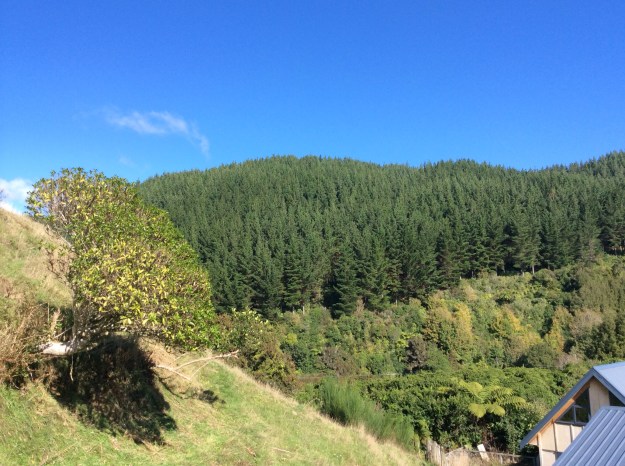

(The view from our room, a little hut on the hill. Perfect.)